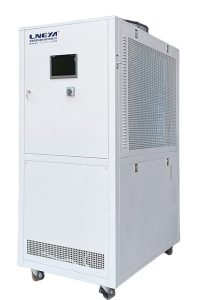
Understanding 1kW Chillers: Technical Aspects and Applications
Introduction to 1kW Chillers
A 1kW chiller is a refrigeration unit that provides 1 kilowatt of cooling capacity, suitable for small to medium-sized applications where precise temperature control is required. These chillers are designed to maintain optimal temperatures in various systems, ensuring efficiency and performance.
Technical Specifications of 1kW Chillers
Cooling Capacity: A 1kW chiller has a cooling capacity of 1 kilowatt, which is equivalent to approximately 3.52 tons of refrigeration. Temperature Control: These chillers can maintain a precise temperature control, often with a precision of ±0.5°C. Refrigerants: Common refrigerants used in 1kW chillers include R404A, with options for R507C and R448. Power and Efficiency: The power consumption and efficiency of a 1kW chiller can be calculated using the kW/Ton ratio, where a lower value indicates higher efficiency. Applications of 1kW Chillers
Industrial Processes: 1kW chillers are used in various industrial processes where cooling is required, such as in laser systems, plastic injection molding, and chemical processes. Laboratory Equipment: They are essential for cooling laboratory equipment, including autoclaves, reactors, and measuring instruments. Laser Technology: Specific 1kW chillers are designed for cooling fiber laser systems, with independent cooling circuits for the laser and optical components. Efficiency and Performance of 1kW Chillers
The efficiency of a 1kW chiller is crucial for energy savings and optimal performance. Chiller efficiency can be measured using the Coefficient of Performance (COP), which is calculated by dividing the cooling capacity in kW by the power input in kW. A higher COP indicates a more efficient chiller.
Choosing the Right 1kW Chiller
When selecting a 1kW chiller, consider the following factors:
Cooling Demand: Ensure the chiller’s capacity matches the cooling demand of the application. Efficiency: Look for chillers with high COP and low kW/Ton values for better energy efficiency. Refrigerant Type: Choose a chiller with environmentally friendly refrigerants, such as those with low Global Warming Potential (GWP) values. Size and Space: Consider the physical dimensions of the chiller and the available space for installation. Conclusion
A 1kW chiller is a versatile and efficient cooling solution for a variety of applications. Understanding the technical specifications, applications, and efficiency factors is essential for selecting the right chiller. By choosing a high-efficiency 1kW chiller, users can ensure optimal performance and energy savings in their cooling applications.
The article provides an overview of 7-ton chillers, focusing on their performance, applications, market trends, technological developments, and environmental impact. The abstract captures the key specifications of 7-ton chillers, such as cooling capacity, compressor types, and refrigerants used. It also highlights the growing demand for energy-efficient and environmentally friendly chiller solutions in various industries, including semiconductor manufacturing and industrial processes.
A 12 kW chiller is a compact and versatile cooling system suitable for a variety of commercial and industrial applications. This article provides an overview of the specifications, applications, energy efficiency, and market analysis of 12 kW chillers. The abstract highlights their performance metrics, such as COP and IPLV, and discusses the impact of chiller efficiency on energy consumption and environmental sustainability. It also touches on the market dynamics and growth factors influencing the chillers market, including technological advancements and energy efficiency regulations.
A 1 kW chiller is a compact cooling solution designed for applications requiring up to one kilowatt of cooling capacity. The abstract outlines the key features of 1 kW chillers, such as their suitability for small-scale processes, the importance of energy efficiency, and the selection criteria based on cooling needs. It also addresses the operational principles, maintenance requirements, and the potential environmental impact of these chillers.
A 3-ton glycol chiller is a refrigeration system designed to provide precise cooling for applications requiring low temperatures, typically using a glycol-water mixture as the heat transfer fluid. With a cooling capacity of 3 tons (36,000 BTU/hr), it is suitable for small to medium-scale operations in industries such as food and beverage, pharmaceuticals, breweries, and HVAC. Glycol chillers are preferred for their ability to prevent freezing and corrosion, ensuring reliable performance in sub-zero conditions. Key features include energy efficiency, compact design, and adaptability to various cooling needs. This guide explores the working principles, components, applications, and benefits of a 3-ton glycol chiller.
 Industrial Chiller Heater Equipment Supplier-LNEYA